Patriarch Bartholomew I: “Mercy is not a peripheral virtue nor merely an emotional disposition. It is the very mode by which God enters the world and restores what has been fragmented. If we truly desire to offer credible witness before humanity, we must allow mercy to become the principle of our ecclesial life, the criterion of our relations and the horizon of our common pilgrimage.”
By Chris Sparks
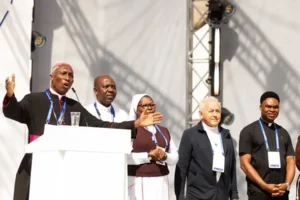
June 8, 2026, day 2 of WACOM6, opened on the Hill of the Savior with an address from Cardinal Grzegorz Ryś, Archbishop of Kraków, Poland, the see once held by Cardinal Karol Wojtyla, who would go on to become the Great Mercy Pope, Pope St. John Paul II.
Cardinal Ryś began by introducing the bell of hope stationed across the stage from the podium, one of “18 such bells which have been prepared to create a network of hope around the world,” and inviting Archbishop Grusas to join him in tolling it.
The cardinal continued by telling the story of the founding of the Ospedale di Santo Spirito in Sassia by Pope Innocent III, originally to care for unwanted infants. This one work of mercy inspired many, many others, explained the Cardinal. Drawing on Scripture, tradition, and the papal Magisterium, especially the apostolic exhortation Dilexit Te by Pope Leo XIV, the Cardinal explored the Christian understanding of mercy, always united to justice.
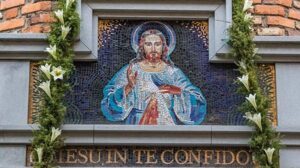
Next came John Pridmore, a former member of the London criminal underground. He opened with a powerful prayer and a story of a friend, a former skinhead, whose life was transformed by finding a Divine Mercy Image in a public phone booth. Shortly after finding the Image, he saw the same Image on the outside of a Catholic Church. When he went in and asked why he felt the presence of God so strongly in the Church, they responded that Catholics believe in the Real Presence of Jesus in the Eucharist. Eventually, the friend became a Franciscan, and was one day called upon to celebrate a funeral Mass. During the funeral, he heard the man be eulogized for being outstanding for placing Divine Mercy Images in public places, like phone booths.
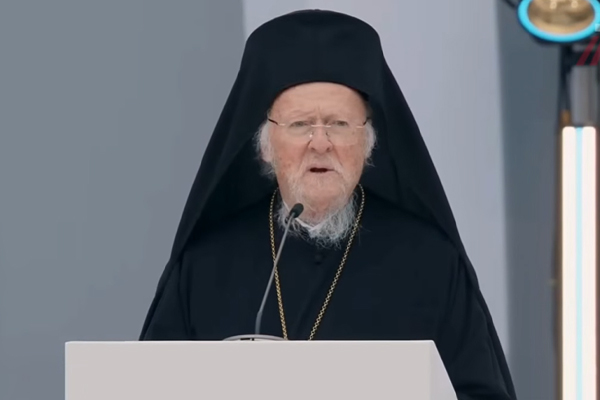
After Pridmore’s powerful testimony to mercy, Patriarch Bartholomew I of Constantinople addressed the Congress, “conveying the fraternal blessings of the church of Constantinople.” This was a historic moment of ecumenical participation in WACOM. Though past WACOMs had welcomed various leaders of Eastern Orthodox Churches, this was the first time the Patriarch of Constantinople, the earthly head of an ancient see of enormous historical and ecclesiastical importance in Christianity, had participated.
The Patriarch spoke of the wounds of the past, how they had impeded the whole Christian communion from living its witness to the mercy of God faithfully, fully, and well, and how the present moment demanded better from all of us Christians.
“The familiar repetition in our liturgical assemblies of the petition, ‘Lord, have mercy,” contains a staggering invocation for healing,” said the Patriarch, explaining how the similarity between the Greek words for “mercy” and for “oil” “shifts the entire weight of human failure from guilt to illness. The whole ecclesial community supplicates that the medicinal oil be poured onto the open wound; that our body be healed.”
And the times demand that such healing be sought between God and man, but also between Christians, as a matter of priority, he made clear. “We live in a technological landscape entirely fluid and demanding, where the very algorithm of social media operates with the exclusive, perhaps, purpose of commercializing human attention, feeding ceaselessly on polarization and magnifying artificially and methodically the distance between persons. This prevailing culture of consolation comes to stand as the most merciless opposite of evangelical mercy. A memory is created that refuses to forgive, that takes human error and digitalizes it, converting it into an eternal condemnation.”
“Mercy is not a peripheral virtue nor merely an emotional disposition,” Patriarch Bartholomew explained. “It is the very mode by which God enters the world and restores what has been fragmented. If we truly desire to offer credible witness before humanity, we must allow mercy to become the principle of our ecclesial life, the criterion of our relations and the horizon of our common pilgrimage.”
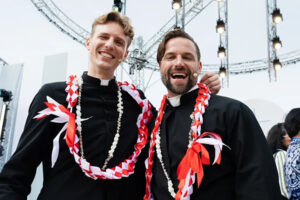
Mass was celebrated at noon. The concelebrants wore vestments specifically prepared for the Congress. The lead celebrant was the Lithuanian Cardinal Rolandas Makrickas, coadjutor archpriest of the Papal Basilica of Saint Mary Major.
In his homily, Cardinal Makrickas said, “In this meaningful place, on this hill of Vilnius, we are at the heart of the Divine Mercy, where the little Sister Faustina received the great message that now resounds throughout the world.”
“Saint Sister Faustina, right here in Vilnius, received the message of Jesus, message of Mercy: ‘Jesus, I trust in You.’ This is the key to everything.”
“May the Virgin Mary, in Vilnius venerated with the title of Mother of Mercy, Saint Sister Faustina, and Saint John Paul II, intercede for us, so that this Congress may not remain only a beautiful memory, but the beginning of a life more deeply rooted in His Divine Mercy. And with the simple words of Saint Faustina, let us repeat every day: ‘Jesus, I trust in You.’”
The afternoon was dedicated to workshops spread through the city of Vilnius (many in the Old Town), focused on works of mercy, beginning at 3 p.m., the Hour of Great Mercy, with the Divine Mercy Chaplet.
At 7 p.m. on the Hill of the Savior, participants were welcomed to a Reconciliation Service, allowing them a personal experience of the Divine Mercy.